One of the things I particularly like about the life coaching program at UCSF (which I'm a few courses from finishing) is that they put a lot of emphasis on positive psychology, a new movement within the healing arts that's gaining a lot of attention.
One of the most striking tenets, particularly for anyone with some background in traditional psychology, is that it's generally not all that helpful to dig around for the root causes of an unwanted behavior.
For anyone invested in the old paradigm, this is darn near heretical. Not spend hours digging into one's childhood, trying to resurrect hidden traumas and mis-learnings? How can you even call that psychology?
But the Freudian notion that uncovering the roots of a neurosis is akin to curing it has steadily lost credibility. Awareness is one thing. But getting rid of bothersome behaviors also requires diligent work to construct healthier replacement behaviors. Insight into the roots of the old behaviors isn't necessarily going to help in that endeavor, and it may hinder a person by keeping him trapped in the past.
"The promissory note that Freud and his followers wrote about childhood events determining the course of adult lives is worthless," Martin Seligman, the godfather of positive psychology, writes in his groundbreaking book "Authentic Happiness."
Seligman's prescription for improved mental hygiene is to focus on building positive behaviors and habits -- gratitude, optimism, savoring pleasures -- rather than devoting a lot of attention to the behaviors you want to lessen. You'll enjoy it more, and your healthy new behaviors will steal time from the old ones. In short, starve your neuroses rather than hunting them down and trying to club them to death.
Again, this may seem heretical to anyone who's had much to do with traditional psychology, but there's a lot to recommend the approach. For starters, it seems that a lot more people might be willing to give positive psychology a try than the old model. "Relive past traumas in full, gory detail!" is a hard idea to sell. "Practice being happy" would seem to have much better legs, marketing-wise.
And it seems one would be much more likely to stick with a process that focuses on exploiting and developing one's strengths, as positive psychology promotes, rather calling attention to deficiencies.
Further, most of the arguments against positive psychology boil down to naive and puritanical variations on "No pain, no gain." Fine, maybe, for a masochist. But, notwithstanding my Lutheran upbringing, I'm a firm believer that there's no inherent virtue in doing something the hard way. Sometimes, hard is just hard.
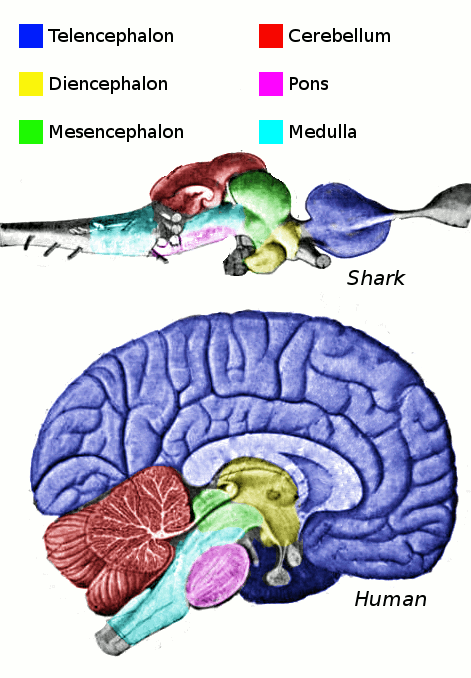
I was enjoying yet another lecture on neurology and brain function recently when I was struck by the plastic brain model used to illustrate the lesson.
I don't know if it was the construction, the way different brain segments were colored or what, but a somewhat familiar thought occurred to me with wholly new force: This is not a new brain. This is a basic mammal brain with a bunch of cortex glopped on top.
Now, any engineer will tell you that an old machine retrofitted to serve a new function never works as well as a machine designed specifically for that function. The re-jiggered machine will be big and clumsy, have redundant or useless parts, require complicated rewiring, etc..
Which is precisely what nature has gifted us with, noggin-wise. Yes, we have this big, nifty new cortex that can perform complicated math calculations, compose symphonies and cure polio. But we also have the old brain that evaluates everything strictly in threat/not threat terms, assumes ill intent just to be safe and treats every condition as permanent and irreversible.
And, given the way the parts are situated, the old brain always bats first. Yes, your cortex understands that the TV screen is showing a representation of a lion jumping at something, perfectly safe, notice the coloration on the tail. But in the time it has made those conclusions, the old brain has already made you jump and sweat with its message of "WE"RE GONNA DIE!"
A parable: When I was 10, I lobbied heavily for a new bicycle to replace the coaster-brake clunker I was outgrowing. Three-speed bikes were the norm at that point, and 10-speeds were gaining traction, so I made it clear to my Dad that I needed at least a three-speed model.
My Dad couldn't bear to get rid of anything that still worked, however, especially if it meant spending money for a replacement. Instead of a new bike, he found a Sears kit that supposedly turned a single-speed bike into a three-speed. Installed on my old bike with a few additional adjustments, he tried to sell me on the idea that I now had a brand new three-speeder.
But one ride around the block made the truth obvious to me: I had the same crappy bike, now with this ugly plastic tumor on the crank that played around with chain tension in a half-assed attempt to imitate an actual selection of gears.
And that, metaphorically, is what makes our mental lives so full and challenging. We're trying to navigate the complex, hilly terrain of a modern life full of symbols and ambiguities with the mental equivalent of a single-speed bike inherited from our ancestors.
Yes, we have all sort of dandy new systems bolted on to the old one. But sometimes the proof is in the ride.